Before the Sequel: How Serial Film Stories Found Their Shape
Serial film storytelling took shape in early cinema through cliffhangers, recurring heroes and linked adventures, each offering a distinct reason to return.
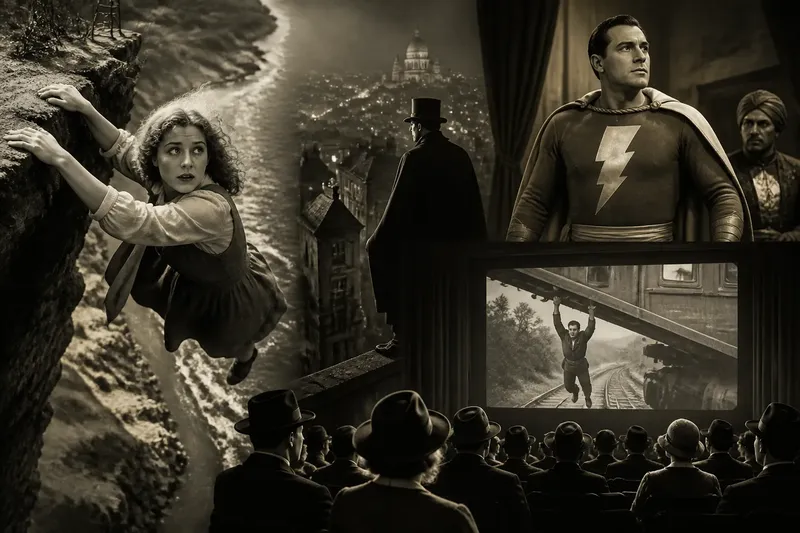
A hero hangs from a ledge as the last frame fades; the answer waits until next week. Serial film storytelling made that interval part of the entertainment, long before the feature-film sequel became a familiar event. In early cinema, instalments offered several ways to bring audiences back: a perilous pause, another adventure with a known hero, or a continuing story that opened onto a larger world.
These formats are easier to distinguish when set beside actual screen history. The French serial Fantômas, directed by Louis Feuillade, appeared in instalments in 1913. In the United States, The Perils of Pauline followed in 1914, with Pearl White as its resourceful heroine. Later chapter plays such as Republic Pictures’ Adventures of Captain Marvel (1941) carried the serial form into the sound era. Their differences reveal that a serial was not simply a feature film divided into pieces: its structure shaped what audiences were asked to remember and anticipate.
Why did early serials suit cinema programmes?
In the silent era, serials were commonly shown as chapters within cinema programmes. Their recurring characters and situations gave audiences a reason to return to the next chapter, while the break between screenings left room for anticipation. Chapter endings could place a protagonist in immediate danger, a device that became closely associated with the form.
The Perils of Pauline helped make the cliffhanger heroine a recognisable screen figure. Its chapter-by-chapter design put Pauline in peril and withheld the outcome until a later instalment. The serial’s central attraction was not only the question of escape. It was also the return of Pearl White’s character, whose ingenuity gave the audience a familiar presence amid changing dangers.
Not every serial depended on a single unresolved crisis. Feuillade’s Fantômas follows the criminal Fantômas and the people pursuing him through a succession of episodes. Its urban settings, disguises and shifting identities build an atmosphere of intrigue across the whole work. That approach makes the serial feel less like a string of isolated cliffhangers and more like a continuing criminal world.
For an audience, each structure offered a different pleasure: urgent suspense, renewed company with a familiar character, or the gradual accumulation of a story’s setting and conflicts. A serial could combine these, but one promise usually led.
How did cliffhanger chapters keep audiences waiting?
A cliffhanger chapter makes an immediate question carry across the interval between episodes. A character may face a fall, a locked door or an approaching pursuer. The ending holds back the outcome; the next chapter must then answer it rather than pretend the danger never mattered.
The Perils of Pauline is a well-known early example of this pattern. Its title character faced dangers that gave each chapter a sharp local focus, while the serial’s continuing appeal rested on seeing how Pauline responded. The arrangement gave audiences both a prompt to return and a familiar protagonist to follow.
The form becomes less satisfying when the cliffhanger is only a cut-off. If the next instalment cancels the danger without consequence, the pause feels empty. A stronger chapter resolves the immediate peril and lets the escape alter what comes next: a rescued character might now distrust their helper, or a recovered object might point towards a larger threat.
Say an invented adventure serial ends with a courier trapped in a railway station as a rival closes in. In the next chapter, the courier slips through a staff corridor, then discovers the rival has taken the message. The courier escapes, so the immediate danger is answered; the lost message changes the pursuit. The result is a completed beat and a fresh reason to continue, rather than another suspended scene.
Cliffhangers suit stories built around pursuit, rescue and confrontation. Give the characters choices that shape the next chapter, and the danger feels like part of the story rather than a trick at the edit.
Why did recurring heroes matter as much as suspense?
A serial can invite audiences back through a protagonist as much as through an unanswered question. The hero’s habits, skills and relationships offer a stable centre, even when the next episode brings a different obstacle. This is one reason serials could sustain interest beyond a single peril.
Later sound serials made that recurring appeal especially clear. Adventures of Captain Marvel, released by Republic Pictures in 1941, brought the comic-book hero to the screen in chapter form. Captain Marvel’s identity and powers supplied a recognisable foundation, while the ongoing adventure provided the larger thread. The chapter format let the serial return to a familiar hero and keep the central conflict moving.
Recurring-adventure storytelling is not the same as a sequence of unrelated stories. An episode may offer a local problem and resolution while changing a relationship or revealing a limit in the protagonist’s usual approach. If every obstacle produces the same response, familiarity can become repetition. A small change in trust, method or confidence can make a known character feel alive rather than merely recognisable.
This structure works especially well when the audience’s main pleasure is spending time with a particular hero or partnership. It is less suited to a story whose force depends on one tightly controlled mystery reaching a single final answer.
When does a serial make its world the attraction?
Some serials draw interest from a world that grows more legible with each instalment. Returning locations, institutions and rivalries connect events, even when the focus shifts between characters. The audience comes back not just to learn what happens, but to see how separate parts of the story fit together.
Fantômas offers a useful early example. Its sequence of episodes returns to the pursuit of the elusive criminal, but its changing disguises and city settings broaden the sense of a world shaped by secrecy and uncertainty. The continuing thread gives the audience direction; the changing encounters keep the serial from being only a repeated chase.
A world-led serial can follow an ensemble, with different instalments revealing the pressures on different people. That freedom also creates a risk: if each episode assumes too much knowledge of previous events, a new viewer may struggle to understand the present conflict. Brief reminders and a clear reason for each chapter to matter now can preserve continuity without turning it into bookkeeping.
Imagine an invented screen story about a coastal community after a storm. One instalment follows the harbour repair crew, another a shopkeeper trying to reopen, and a later one a council meeting about the damaged shoreline. The same places and decisions connect the chapters, while each has its own immediate problem. The result is a community story rather than a single hero’s uninterrupted adventure.
Which serial form fits the story you want to follow?
What is a film serial?
A film serial is a screen story released in separate instalments linked by a continuing plot, protagonist or fictional world. Its chapters may end on unresolved danger, offer local adventures, or combine both structures.
How is a serial different from a sequel?
A serial is organised as a sequence of chapters, often designed to continue the story directly from one instalment to another. A sequel is a later work that returns to an earlier story; it may stand on its own, or depend heavily on the previous film.
Why did early serials use cliffhangers?
A cliffhanger carried an unanswered outcome across the break between chapters, giving audiences a direct reason to return. The device worked best when the following instalment dealt honestly with the danger and let the characters’ response affect events.
Are film serials the same as modern television series?
Both forms tell stories across instalments, but their production and exhibition histories differ. Early film serials were made for cinema programmes and released as chapters; television series developed within a different medium and schedule, with formats that range from episodic stories to continuous narratives.
How can you tell which structure serves a story?
Start with the reason an audience would want another instalment. If the pleasure lies in discovering the outcome of a pressing danger, a continuing plot and carefully earned cliffhangers may fit. If viewers want renewed company with a familiar cast, recurring adventures can provide a local resolution each time. If the subject is a community or an intricate setting, shifting focus between connected parts may be more revealing.
Then consider how much information the audience must carry between chapters. A story released with long gaps can use brief reminders and a clear present-tense problem. A tightly linked run can ask viewers to remember more, but each instalment still needs a meaningful event of its own. Continuity should deepen the current chapter, not replace it.
These methods can coexist. A recurring hero can face a cliffhanger during a larger conflict, and a world-led serial can stay with one character for several chapters before shifting perspective. The structure feels coherent when its central invitation remains clear.
Serial film storytelling took shape through choices about what audiences should carry across the interval: a danger awaiting its answer, a hero worth meeting again, or a world whose connections are still unfolding. Named examples make that history more than a general idea. The Perils of Pauline shows how peril could organise a chapter, while Fantômas and Adventures of Captain Marvel show how a continuing figure and story could sustain the return. The interval matters most when the next instalment gives it a consequence.